








THE FILM
Writer/Director
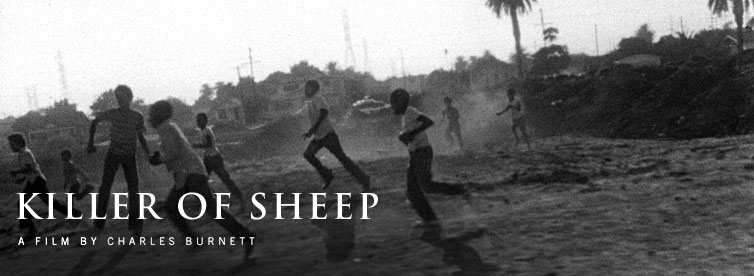
Charles Burnett submitted his first feature, Killer of Sheep, as his
thesis for his MFA in film at UCLA. The film was shot on location near
his family's home in Watts in a series of weekends on a shoestring
budget of less than $10,000, most of which was grant money.
With a mostly amateur cast (consisting of Burnett's friends and acquaintances), much handheld camera work, episodic narrative and gritty documentary-style cinematography, Killer of Sheep has been compared by film critics and scholars to Italian neorealist films like Vittorio De Sica's The Bicycle Thief and Roberto Rossellini's Paisan. However, Burnett cites Basil Wright's Song of Ceylon and Night Mail and Jean Renoir's The Southerner as his main influences.
In 1981, Killer of Sheep received the Critic's Award at the Berlin International Film Festival. In 1990, the Library of Congress declared it a national treasure and placed it among the first 50 films entered in the National Film Registry for its historical significance. In 2002, the National Society of Film Critics selected the film as one of the 100 Essential Films of all time.
2017 marks the 40th anniversary of this landmark film and Milestone is celebrating with a worldwide tour of this classic film along with Billy Woodberry's Bless Their Little Hearts with script and cinematography by Charles Burnett!
THE RESTORATION
UCLA has long been considered a leader in the preservation of classic
Hollywood cinema, but increasingly in recent years they've also been preserving the
very best of American independent cinema. At technical level Killer of Sheep
demanded immediate attention, as it was already deteriorating when we received the
material in 2000. The original 16mm A/B rolls as well as the magnetic
soundtrack master suffered from vinegar syndrome, putting the film on a ticking
clock.
Killer of Sheep had previously existed only in rough 16mm copies, and the 35mm blow-up restoration better renders the beautiful quality of Charles’ lovely in-the-street cinematography. One of the genuine privileges of doing this work at UCLA is that we're able to apply the best technical resources in LA to a small, low-budget production that would never otherwise benefit from such treatment. But despite the access to high-end resources, we made great efforts to preserve exactly the rough quality of the original, so as not to alter the work. Especially careful attention was given to image contrast and tonality, to carefully bring out the best aspects of the original negative. We're indebted to Film Technology Company for their excellent lab work. We also, with the help of John Polito of Audio Mechanics, conducted close and judicious work on the "verite-like" soundtrack, which was often recorded by the many kids who appear in the film.
— Ross Lipman, preservationist at UCLA Film & Television Archive, has been responsible for the restoration of the films of John Cassavetes, John Sayles, and Kenneth Anger. He is the director of Milestone's release, Notfilm.
Milestone's 2017 release is based on the digital restoration by Modern Videofilm.
THE CAST
THE ACTOR, HENRY GAYLE SANDERS
After
serving for nine years in the US Army, including two tours in Vietnam,
Sanders returned to this country in 1969 — reluctantly. His father had
died during his "harrowing" tours and he was uncertain as to what to do
with his life.
While injured in the service, he had written an autobiographical novel called What Love Has Joined Together, and he resolved to move to either New York or Los Angeles to try to sell it. In the end, he chose Los Angeles (“I figured if I was going to be broke, I might as well be broke and warm.”) where he adapted his novel into a play. As part of his own “self-actualization” program, he studied cinema at Los Angeles City College and took related courses at UCLA under the G.I. Bill.
It is
around this time that Sanders got into acting. “That's when I began to
see where my strengths were,” he says, “Ultimately all of these things
gave me my center. And whatever trauma I may have gone through,
everything comes to bear on my work in fruitful way.” Sanders‘ long
list of films and television credits includes Selma by Ava DuVernay;
DuVernay‘s television series Queen Sugar; the 2006 film Rocky Balboa; a recurring role on
Dr. Quinn Medicine Woman; and guest appearances on Cagney and Lacey,
Knots Landing, Perry Mason, Matlock, Murder She Wrote, ER, Miami Vice,
NYPD Blue, The West Wing, and Joan of Arcadia. He lives in Los Angeles.
THE ACTRESS, KAYCEE MOORE
Moore
had only acted in live theater before Killer of Sheep. Afterwards, she
went on to star in Billy Woodbury‘s Bless Their Little Hearts (1984),
which was written and shot by Charles Burnett. That year, she went back
home to Kansas City, Missouri for a few months to help her mother start
up the Kansas City chapter of the Sickle Cell Disease Association of
America, and she ended up staying on, acting as Executive Director
after her mother's death in 1990.
In 1991, filmmaker Julie Dash, wowed by Moore's performance in Killer of Sheep — particularly the improvised scene in which she is yelling at the characters Smoke and Scooter on the front porch — cast Moore in her 1991 film Daughters of the Dust. After filming, Moore returned to Kansas City to continue her work fighting Sickle Cell Disease. In 1994, she shared the screen with the likes of Isaac Hayes and Martin Sheen in a Kansas City independent film Ninth Street, adapted from a play of the same name. She continues to work at the Kansas City SCDAA as a grant writer and has finished a screenplay entitled Track 14, a historical drama about the Kansas City area.
THE CONTEXT
Clyde
Taylor of New York University coined the phrase, “The L.A. Rebellion”
as a term to refer to the group of young black politically-minded
artists trading ideas and labor at the UCLA Film School in the 1970‘s.
Though Charles Burnett has insisted in several interviews that he and
his fellow filmmakers did not in fact consider themselves part of a
“rebellion” or “movement” as such, and that it was merely a radical
time in American history, he describes the atmosphere at UCLA as one of
camaraderie in radical thought. He called UCLA an “anti-Hollywood”
environment with a “kind of anarchistic flavor to it” in which one “had
to come up with something relevant or extremely well done, original.”
Other directors at UCLA at this time were Julie Dash (Daughters of the Dust, 1991), Haile Gerima (Sankofa, 1993), Billy Woodbury (Bless Their Little Hearts, 1984), and Larry Clark (Passing Through, 1977). Burnett himself was the cinematographer for Gerima‘s Bush Mama (1979), worked crew and camera and edited Dash‘s Illusions (1982) and wrote the script and shot Woodbury‘s Bless Their Little Hearts. Another notable figure is UCLA professor Elyseo Taylor, who started the school's Ethno-Communications department, a program focused on the study and production of films by people of color.
Many of the films that were being made at the time by this peer group have been compared by film critics and scholars to Italian neorealist films of the 1940‘s, the Third World cinema of the ’60s and ‘70s, and the Iranian New Wave of the 90's. A major thematic thread that runs through many of the films is a critical response to White Hollywood and Blaxploitation. “We needed the spectrum,” says Burnett, “the full range of the black experience.”

“Killer of Sheep is one of the most striking debuts in movie history and an acknowledged landmark in African-American film.”
— TERRENCE RAFFERTY, GQ
“Killer
of Sheep represents the highest example of contemporary black American
life put on screen because of Burnett's integrity to view it purely,
without typical corrupted Hollywood devices.”
— ARMOND WHITE, FILM COMMENT